
Service
Dry Needling
Fine needles used to release tight, painful trigger points in muscle — a targeted addition to hands-on treatment and exercise, not a replacement for them.
Separate arrangements for male and female patients
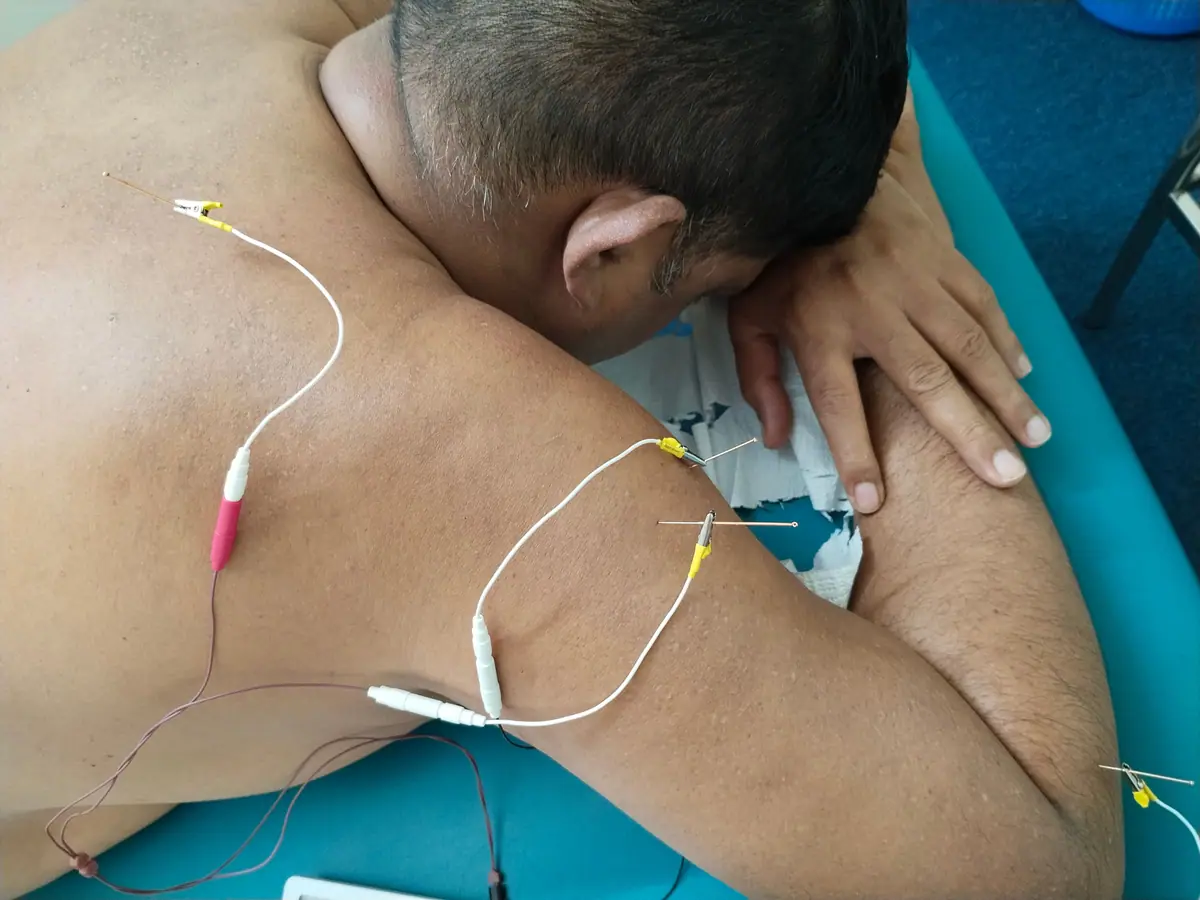
Dry needling uses a very fine, sterile, single-use needle placed directly into a tight, tender band of muscle — what is usually called a trigger point. The word "dry" simply means nothing is injected. The needle itself is the treatment.
It is a useful tool for a specific problem: muscle that has become persistently shortened and irritable, and is referring pain elsewhere. It is not a cure-all, it is not right for everyone, and at Physio Motion it is always used as part of a wider plan rather than as a treatment on its own.
How it differs from acupuncture
The needles look similar, and that is where the similarity ends. Acupuncture comes from traditional Chinese medicine and selects points along meridians according to that system's theory of energy flow.
Dry needling is based on Western anatomy and pain science. The physiotherapist examines the muscle, finds the taut band and the specific tender spot that reproduces your symptoms, and needles that point because of where it sits anatomically. Two clinicians assessing the same shoulder should arrive at broadly the same spots, because they are working from the same anatomy rather than from a separate theoretical framework.
What it is used for
It is most useful when a clear trigger point is found on examination and pressing it reproduces the pain you came in with. If no such point exists, dry needling is not the right tool and we will say so rather than needle for the sake of it.
- Myofascial trigger points — the classic use. Tight, tender knots in muscle that are painful locally and often refer pain some distance away.
- Persistent muscle tightness that has not released with stretching, massage or exercise alone.
- Neck and shoulder pain, including the trigger points that commonly drive tension-type headaches.
- Lower back and gluteal muscle pain, often alongside treatment for the spine itself.
- Some tendon-related problems, such as tennis elbow and heel pain, where the surrounding muscle is contributing to the load.
- Jaw, calf and forearm muscle pain where a discrete trigger point can be identified.
What a session actually feels like
Most people are surprised by how little the needle insertion itself registers. The needles are far finer than an injection needle and there is often no sensation as one goes in.
What you may feel is a brief, deep, cramping ache as the muscle responds, sometimes with a quick involuntary twitch. That twitch is a normal muscular reflex, it lasts a fraction of a second, and it is generally a sign the right spot has been found. It can be startling the first time, which is why we explain it before starting rather than after.
A typical treatment uses a small number of needles, left in place for a short period or removed immediately depending on the muscle and how irritable it is. The needling portion of an appointment is usually brief — the rest of the session is assessment, hands-on treatment and exercise.
Afterwards, and what is normal
Post-needling soreness is common and expected. It typically feels like the ache after unfamiliar exercise, is worst in the first few hours, and settles within a day or two. Some people feel looser immediately; others feel a little sore first and better the following day. Both are normal.
Mild bruising at a needle site is occasional and harmless. Feeling briefly tired or light-headed afterwards is also reported, which is why we ask you to sit for a moment before leaving.
What is not expected is severe or escalating pain, spreading redness, or any difficulty breathing. These are rare, but tell us or seek medical advice promptly if they occur.
Who it is not suitable for
Dry needling is not appropriate for everyone, and this is assessed before it is offered rather than assumed. Tell your physiotherapist if any of the following apply:
- You take anticoagulant medication or have a bleeding disorder.
- You have a needle phobia — this is a common and completely reasonable reason to decline, and there are effective alternatives.
- The area is infected, has an open wound, or has significant skin disease.
- You have a compromised immune system, or lymphoedema affecting the limb.
- You are pregnant — certain sites are avoided, so tell us so treatment can be adapted.
- You have a pacemaker or implanted device, if electrical stimulation is being considered alongside the needling.
It is an addition, not a substitute
This is the part that matters most, and it is where dry needling is most often oversold. Releasing a trigger point can reduce pain and restore movement — but it does not, on its own, change why the muscle became overloaded in the first place.
If a tight upper trapezius is the product of a workstation that forces your head forward all day, needling it will help for a while and the trigger point will return. The lasting change comes from the strengthening, the movement retraining and the practical adjustments. Dry needling is valuable precisely because it can reduce pain enough to make that active work possible sooner.
So at Physio Motion it is offered as one component within a plan that also includes hands-on treatment and progressive exercise — see pain management for how that plan is usually built. If you would rather not be needled, say so; the rest of the treatment stands on its own.
Frequently asked questions
Does dry needling hurt?
The needle insertion is usually barely felt. You may feel a brief deep ache or a quick muscle twitch when the trigger point is reached, which lasts a moment. Most people describe it as odd rather than painful.
Is dry needling the same as acupuncture?
No. The needles are similar but the reasoning is different. Acupuncture follows traditional Chinese medicine theory; dry needling targets specific trigger points identified by Western anatomical examination.
How sore will I be afterwards?
Mild soreness like the ache after unfamiliar exercise is common, worst in the first few hours and usually gone within a day or two. Occasional small bruising is harmless.
How many sessions will I need?
It varies with the muscle and how long the problem has been present. It is normally used over a small number of sessions within a wider treatment plan, not as an open-ended course on its own.
Can I have dry needling if I take blood thinners?
Tell your physiotherapist before treatment. Anticoagulant medication, bleeding disorders, local infection, pregnancy and needle phobia all affect whether it is suitable, and there are effective alternatives if it is not.
Conditions we treat with this service
- Neck Pain Neck pain, cervical spondylosis, nerve pain into the arm and neck-related headaches — treated with hands-on care plus targeted strengthening.
- Tennis Elbow Outer elbow pain and painful gripping treated with progressive tendon loading — the approach that actually produces lasting change.
- Low Back Pain, PLID & Sciatica Back pain, disc prolapse (PLID) and sciatica — assessed properly, then treated with hands-on care and a progressive exercise plan.
- Heel Pain That sharp first-step morning heel pain — treated with calf and foot loading, hands-on work and practical footwear changes.
Not sure which applies to you? Get in touch and we will point you in the right direction, or browse all our services .
Ready to start treatment?
Message us on WhatsApp with what is bothering you and when you are free. Tell us if you would prefer a male or female physiotherapist and we will schedule accordingly.
Saturday–Thursday, 9:00 AM – 9:00 PM · Friday — closed