
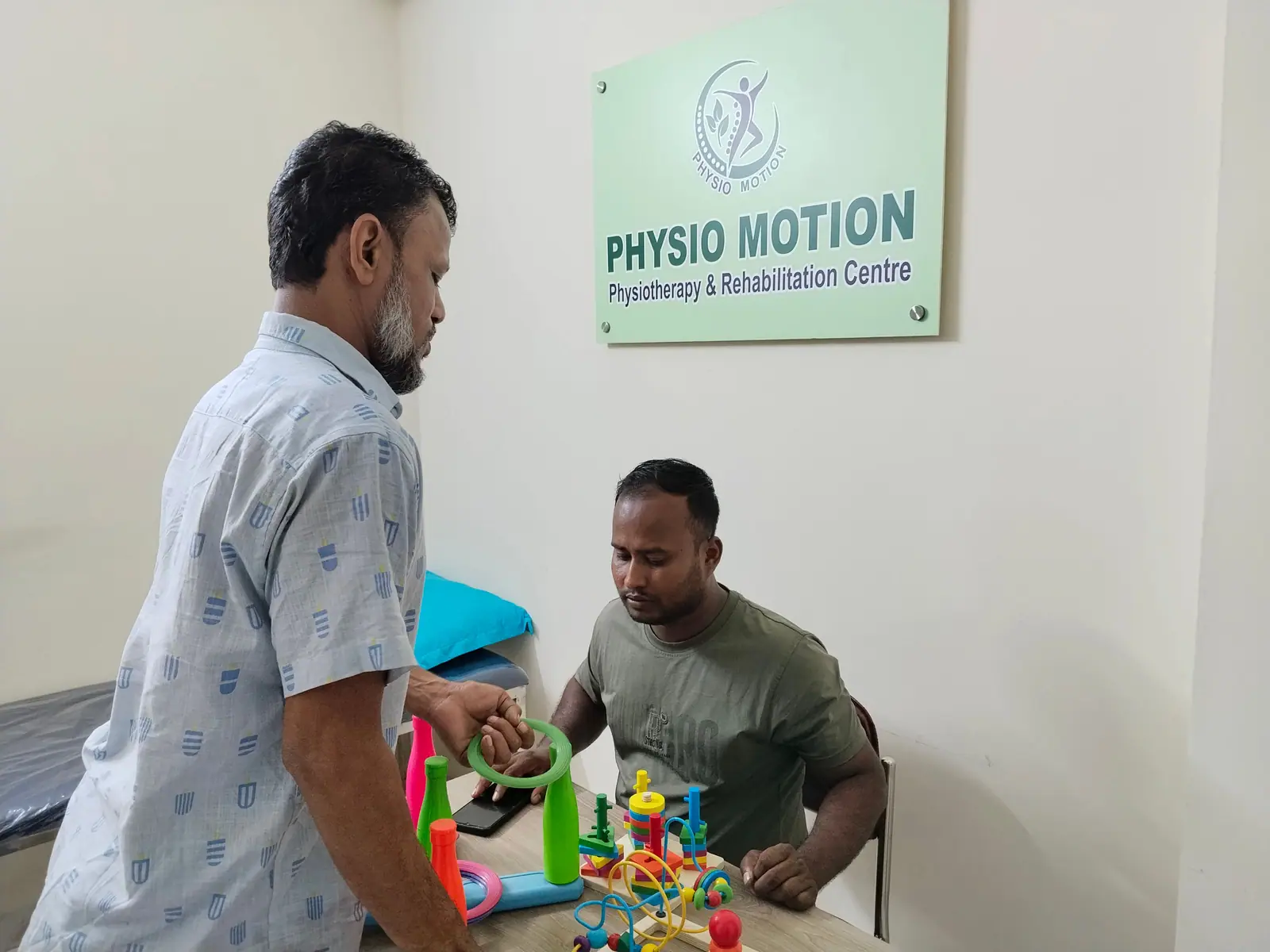
When someone in the family has a stroke, most of the attention — rightly — goes into the emergency. Getting to hospital, stabilising, scans, medication. Then, usually quite abruptly, the patient is discharged home and the family discovers that the hardest and longest part is only beginning, and that almost nobody has explained what to do.
This guide is written for that moment. It is aimed at families in Dhaka who are about to become, in practice, the main providers of a stroke survivor’s daily rehabilitation.
Why recovery is possible at all
A stroke damages part of the brain, and the weakness that follows is a loss of control, not a loss of muscle. The muscles in the affected arm and leg are usually intact. What has been damaged are the pathways that tell them what to do.
The nervous system retains a capacity to reorganise — to recruit different pathways for the same task. That reorganisation is not automatic and it is not driven by rest or by medication. It is driven by repeated, specific, progressively harder practice of the movements you want to recover.
This single fact explains almost everything about how stroke rehabilitation works, including why the family matters so much. Recovery is proportional to meaningful practice, and there are far more hours at home than in any clinic.
When should rehabilitation start?
Generally as soon as the patient is medically stable, on the treating doctor’s advice. Early rehabilitation is not about pushing hard — it is largely about preventing the secondary problems that develop startlingly fast in someone who is not moving:
- Joint contracture — muscles and joint capsules shorten when a limb is held in one position for weeks, and a stiff shoulder or a tight ankle can permanently limit function even after control returns
- Shoulder pain and subluxation on the weak side, which is common, painful, and largely preventable
- Pressure areas from prolonged positioning
- General deconditioning — strength and cardiovascular fitness decline quickly with bed rest, and every week of decline is a week that has to be rebuilt
A common and costly misunderstanding is to wait for recovery to appear before starting rehabilitation. The relationship works the other way round.
What stroke rehabilitation actually involves
Assessment first
A proper assessment records a baseline: voluntary control in each limb, muscle tone, sensation, balance in sitting and in standing, and how much assistance each functional task currently requires.
That baseline matters more than it might seem. Progress after a stroke is often gradual, and families living with it day to day frequently cannot tell whether things are improving. Measuring properly is what distinguishes real progress from a good day or a bad day.
Task-specific practice
The core principle is that you get better at what you practise. If the goal is standing up from a chair unaided, the treatment is practising that transfer with exactly the assistance needed, and reducing that assistance as control improves.
Strengthening, tone management, stretching to protect joint range and balance retraining all support that functional goal — but they do not replace practising the task itself. Exercising a leg on a plinth does not automatically produce the ability to walk.
The functions that matter most
Rehabilitation generally works through the abilities that determine independence, roughly in order: rolling and moving in bed, sitting up from lying, sitting balance, transferring to a chair or commode, standing, standing balance, and walking. Arm and hand function is worked on alongside, because eating, dressing and grooming depend on it.
Read more about how this is structured on our stroke rehabilitation page.
Protecting the weak shoulder
This deserves its own section, because it is the most common preventable complication and families are almost never warned about it.
After a stroke, the muscles holding the shoulder joint together can be too weak to do so. The weight of the arm then pulls the joint partly out of position — subluxation. If someone lifts or pulls the patient by that arm during a transfer, the joint takes load it cannot tolerate, and the result is a painful, stiff shoulder.
Once a shoulder becomes painful, everything else stalls. The patient resists movement, practice reduces, and recovery slows across the board.
Practical rules for the family:
- Never pull on the weak arm during transfers — support under the trunk instead
- Do not let the arm hang unsupported for long periods when sitting; rest it on a pillow or table
- Position the arm carefully in bed rather than letting it fall behind the body
- Support the arm when moving the patient
- Tell the physiotherapist immediately if the shoulder becomes painful
The family is the rehabilitation team
In most Bangladeshi households, care after discharge is delivered by family members and attendants. Handled well, this is a genuine advantage — the patient gets far more repetition than any clinic timetable could provide. Handled without instruction, it produces injured carers, painful shoulders and falls.
So insist on being taught. Attend a session with the patient and ask to be shown directly:
- How to assist a transfer safely, protecting both the patient’s shoulder and your own back
- How to position limbs in bed and in a chair to protect joint range
- How to support walking practice without creating a falls risk
- Which exercises to repeat during the day, how many, and how often
- How to set up the home to reduce falls risk — clearing walkways, bathroom safety, lighting, and secure footwear
This is one of the highest-value things a family can do, and a good physiotherapist will welcome the request rather than treat it as an imposition.
Managing expectations honestly
Recovery is usually fastest in the first weeks and months, then continues more gradually. That early period is worth using intensively.
But it is not a closing door. Meaningful improvement in balance, walking quality, endurance and confidence remains achievable much later, including beyond the first year. “It has been too long” is rarely a good reason not to be assessed — though it is fair to expect gains to come more slowly.
What no honest clinician will do is promise a specific level of recovery. It depends on the stroke itself, and it varies substantially between individuals. What should be offered instead is a clear baseline, the next achievable goal, measurement against it, and straightforward reporting of progress. Be wary of anyone who guarantees an outcome, particularly for a fee.
Practical questions families ask
Is home-based physiotherapy possible? Often yes, and in the early period it is frequently the sensible option when travel is exhausting or unsafe. It also lets the physiotherapist see the actual bed height, the real bathroom doorway and the specific stairs the patient must manage — and to train the family in that environment. Home visits are available on request; see our home physiotherapy page.
How often are sessions needed? It depends on stage and goals. Because repetition drives recovery, the home programme carried out by the patient and family is as important as the scheduled sessions.
Can a female physiotherapist attend? Yes — Physio Motion matches male and female patients with physiotherapists accordingly, and this applies to home visits as well as clinic appointments.
What about the arm — will it come back? Arm and hand recovery is generally slower and less complete than leg recovery, partly because the hand requires much finer control. That said, useful function is often achievable, and the arm should not be written off early.
Looking after the carer
One last point, and it is not an afterthought. Caring for a stroke survivor is physically heavy and emotionally relentless, and carers in Bangladesh often do it without relief for months. Back injuries among family carers are common, and so is exhaustion that nobody acknowledges.
Learning correct transfer technique protects you, not only the patient. Sharing the load between family members, where possible, is not a failure of duty. And if you are struggling, say so to the clinical team — it is relevant information, because a carer who is injured or burnt out cannot deliver the daily practice the patient’s recovery depends on.
Getting started
If someone in your family has had a stroke and you are unsure what to do next, an assessment will at least establish where things stand and what the immediate priorities are — even if you decide to manage largely at home afterwards.
Physio Motion provides stroke and neurological rehabilitation in Uttara, Dhaka, with family training built into the programme. You can read more on our neurological and stroke rehabilitation page, or contact us to arrange an assessment.
This article is general information and does not replace individual assessment by a qualified clinician. Always follow the treating doctor’s advice on medical management after a stroke.
Published by Physio Motion, Physiotherapy & Rehabilitation Centre, Uttara, Dhaka. This article is general information and does not replace individual assessment by a qualified clinician.
← All guides