
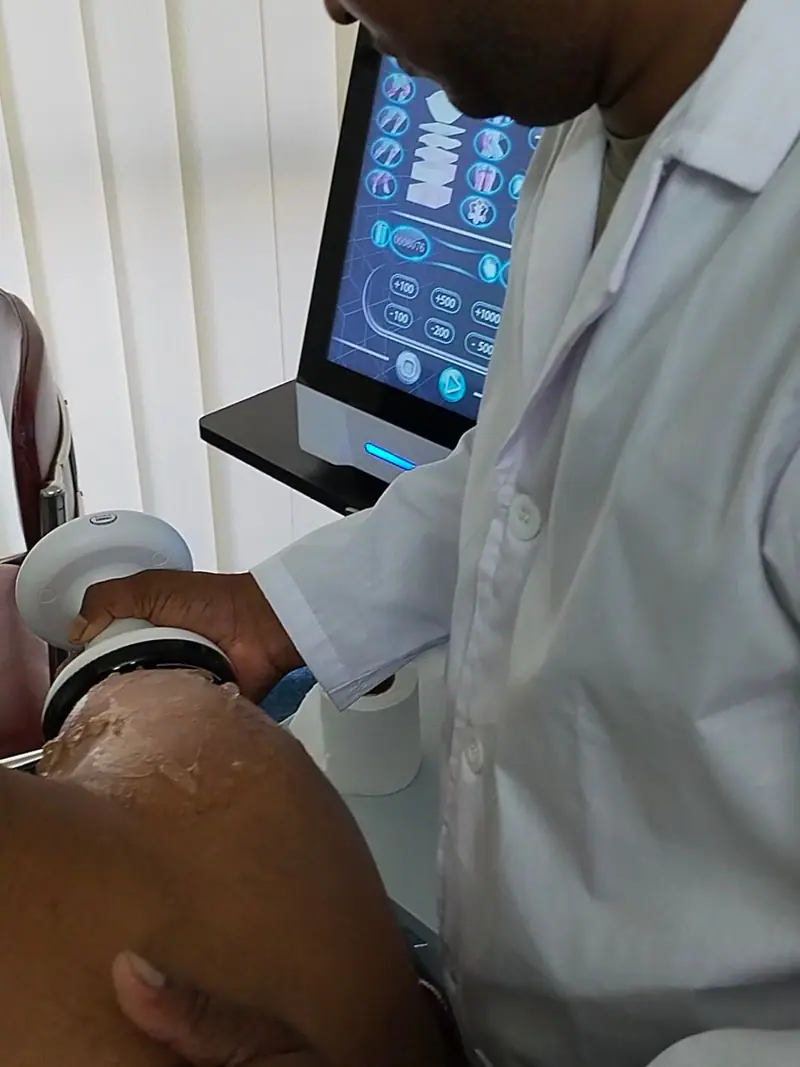
Frozen shoulder is one of the few musculoskeletal conditions where people can often tell you the exact week it started ruining their life. Reaching behind to fasten clothing becomes impossible. Sleeping on that side stops being an option. Ordinary things — taking a wallet from a back pocket, reaching a shelf, putting on a jacket — turn into problems that require planning.
It is also one of the most commonly mistreated conditions, because the treatment that helps in one stage actively harms in another.
What frozen shoulder actually is
The medical name is adhesive capsulitis. The capsule — the sleeve of connective tissue surrounding the shoulder joint — becomes inflamed, thickens and contracts. As it tightens, the joint physically loses the space it needs to move.
The distinguishing feature follows directly from that. In frozen shoulder, the shoulder is genuinely unable to move, not merely painful to move. If someone else lifts your relaxed arm, it still stops at the same point.
That single test separates frozen shoulder from most other shoulder problems. In a rotator cuff problem, active movement hurts and may be weak, but if the arm is relaxed and someone else moves it, the range is usually much better preserved. In frozen shoulder it is not.
Outward rotation — turning the forearm outward with the elbow tucked at your side — is usually the most restricted direction, and it is often the earliest reliable sign.
Who gets it, and why
Frozen shoulder most commonly affects people between roughly 40 and 60, and it is more common in women.
The strongest association is with diabetes. People with diabetes develop frozen shoulder considerably more often than the general population, and it tends to be more stubborn and slower to resolve. If you have diabetes, mention it at assessment — it genuinely changes what a realistic timeline looks like. Thyroid disorders carry an association too.
It can also follow a period of immobility: after an arm injury, after shoulder or breast surgery, or after any spell where the shoulder was kept still. Often, though, it appears without any identifiable trigger, which patients find frustrating and which does not change the treatment.
The three stages
Understanding the stage matters more than almost anything else here, because the right treatment differs sharply between them.
Stage 1 — Freezing
Pain dominates and progressively worsens. It is frequently severe at night, and disturbed sleep is often what finally drives people to seek help. Movement gradually reduces, partly from the capsule tightening and partly from guarding against pain. This stage commonly runs a few months.
Stage 2 — Frozen
Pain begins to settle, but stiffness reaches its worst. The shoulder may hurt less at rest while doing dramatically less. Reaching behind the back, overhead, or across the body becomes very difficult, and dressing, grooming and washing are affected.
Stage 3 — Thawing
Movement gradually returns over months as the capsule loosens. Recovery is slow but generally continues in the right direction.
Why the stage changes the treatment
This is the practical heart of it.
During the painful freezing stage, aggressive stretching usually makes things worse. The capsule is inflamed and irritable; forcing it inflames it further, increases pain, and can extend the painful phase. The well-meaning advice to push through the pain is, at this stage, wrong.
What helps in stage 1 is pain control and maintaining what range you still have: gentle mobilisation within a comfortable range, positioning advice for sleeping, and modifying the activities that provoke it. Night pain in particular often responds well to specific positioning — typically lying on the unaffected side with the painful arm supported in front on a pillow, so it is not hanging or compressed.
Once the joint becomes less irritable, treatment must shift decisively toward restoring range. In stage 2, gentle is no longer enough. This means sustained joint mobilisation and stretching held long enough to influence the capsule, progressed steadily. Short, frequent daily sessions at home outperform occasional intensive effort.
Throughout both stages, the rotator cuff and shoulder blade muscles need rebuilding. A shoulder guarded for months loses considerable strength and control, and that does not return by itself when the stiffness resolves — which is why some people regain range but still feel their shoulder is not right.
You can read more about how we stage and treat this on our frozen shoulder page.
What it is not
Several conditions get confused with frozen shoulder, and they need different management:
- Rotator cuff problems — painful and often weak, but passive range is better preserved
- Shoulder osteoarthritis — can also restrict passive movement, but has a different history and X-ray appearance
- Calcific tendinitis — can cause sudden, severe shoulder pain
- Referred pain from the neck — neck problems can produce shoulder pain with entirely normal shoulder movement
This is why assessment tests both active and passive movement rather than relying on the description alone.
The recovery timeline
Frozen shoulder is slow, and being honest about that is more useful than optimism.
The full natural course commonly runs somewhere between one and three years. It is generally self-limiting — most shoulders do eventually thaw — but “eventually” can mean a very long time, and waiting it out means months of poor sleep and lost function.
Appropriate physiotherapy generally improves range and function faster than waiting, reduces pain along the way, and — importantly — helps prevent the secondary problems that develop when a shoulder is not used for a year: weakness, altered movement patterns and neck pain from compensating.
Diabetic frozen shoulders typically sit at the longer end of that range. That is not a reason to skip treatment; it is a reason to start earlier and be consistent.
When to consider other options
If progress stalls despite consistent, well-staged treatment, other options exist. Corticosteroid injection can be useful, particularly in the painful stage, to reduce pain enough to allow mobilisation. Hydrodilatation, and less commonly surgical release or manipulation under anaesthetic, are considered in resistant cases.
These are decisions to make with a doctor or orthopaedic surgeon. The point worth making here is that they work best alongside rehabilitation, not instead of it — an injection that reduces pain without any subsequent work to restore range tends to buy time rather than resolve the problem.
Practical advice while you recover
- Keep using the arm within comfortable limits. Complete disuse accelerates stiffness and weakness.
- Sort out your sleeping position early. Lying on the unaffected side with the painful arm supported on a pillow in front helps most people. Night pain is often the most exhausting part.
- Do little and often. A few minutes several times a day beats one long session.
- Expect asymmetric progress. Outward rotation is usually the last to return.
- Watch your neck. Months of compensating for a stiff shoulder commonly produces neck and upper back pain; see our neck pain page if that develops.
- If you have diabetes, keep control tight. It is associated with how these shoulders behave.
Will it come back?
Recurrence in the same shoulder is uncommon. The opposite shoulder can be affected at some point, which is more likely in people with diabetes.
Once your shoulder has recovered, keeping it moving through its full range and maintaining reasonable strength is sensible — both to protect the recovered side and because it makes any future problem easier to catch early.
Getting assessed in Uttara
If your shoulder has become stiff as well as painful, particularly if it is disturbing your sleep, it is worth having it assessed rather than waiting to see whether it settles. Identifying the stage is what determines whether you should currently be protecting the joint or working to stretch it — and getting that backwards costs months.
Physio Motion provides shoulder assessment and treatment in Uttara, Dhaka, with male and female physiotherapists matched to patient preference. Contact us to arrange an assessment, or read more about our pain management approach.
This article is general information and does not replace individual assessment by a qualified clinician.
Published by Physio Motion, Physiotherapy & Rehabilitation Centre, Uttara, Dhaka. This article is general information and does not replace individual assessment by a qualified clinician.
← All guides