
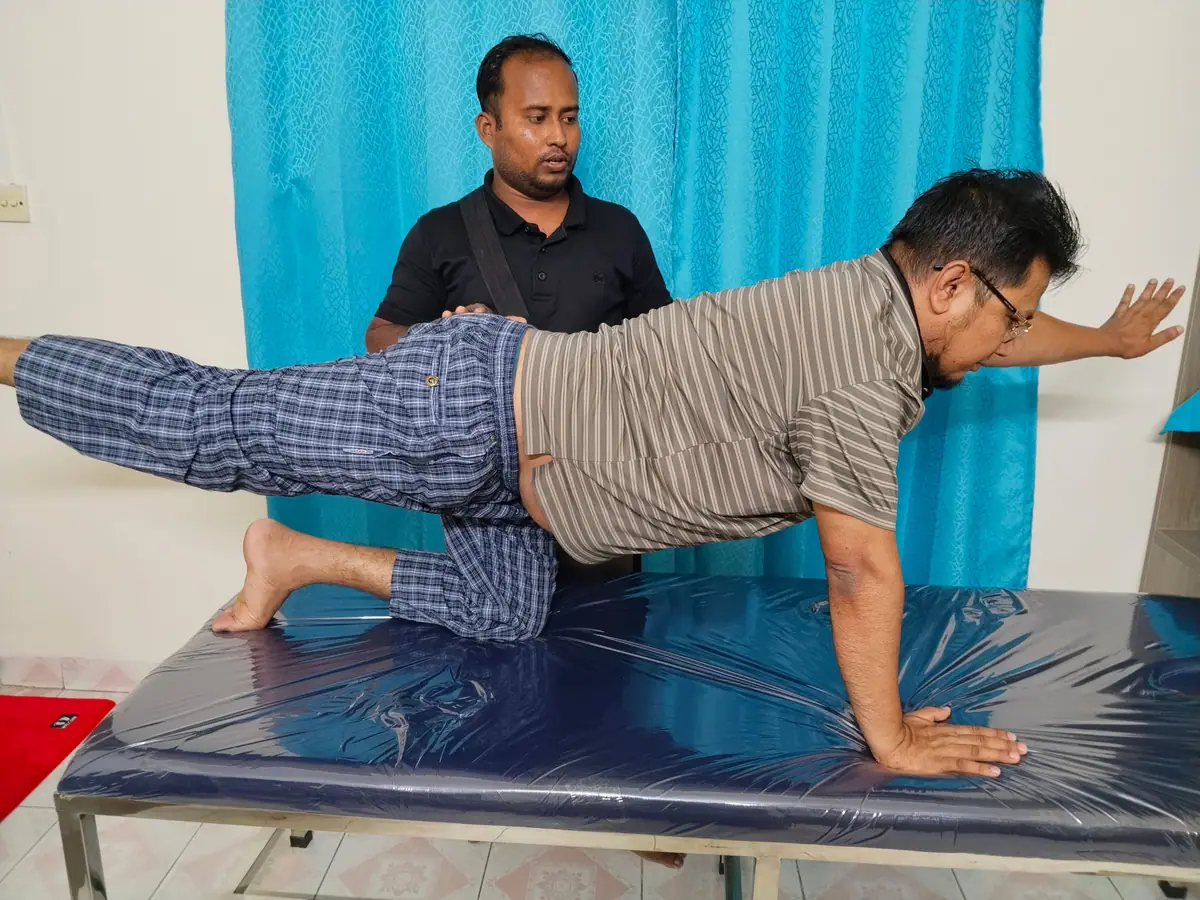
If you live in Uttara and your back has been hurting for more than a few weeks, you have probably already been given a lot of advice. Rest it. Do not rest it. Get an MRI. Avoid bending. Wear a belt. Someone has almost certainly mentioned PLID.
Some of that advice is sound and some of it will actively slow your recovery. This guide sets out what the evidence actually supports, written for people dealing with back pain rather than for clinicians.
Most back pain is not caused by damage
The single most useful thing to understand is that the large majority of back pain is not a sign of structural damage. It is what clinicians call non-specific mechanical back pain — the tissues of the back have become irritated and sensitised, movement has become guarded, and the muscles that normally control the area have stopped doing their job properly.
That sounds dismissive. It is the opposite. Pain from a sensitised, deconditioned back can be genuinely severe and genuinely disabling. But it also means the problem is largely reversible, because nothing is broken that needs to be repaired. What needs to change is how the back moves, how strong it is, and how sensitive it has become.
This matters because the alternative belief — that something in your spine is damaged and must be protected — leads directly to the behaviours that keep back pain going: avoiding movement, bracing constantly, stopping exercise, and waiting for the pain to disappear before returning to normal life.
The PLID and MRI problem
In Bangladesh, back pain is very often labelled PLID — prolapsed lumbar intervertebral disc — frequently on the strength of an MRI report rather than a physical examination.
Here is the difficulty with that. Disc bulges are extremely common in people who have no back pain at all. Studies scanning pain-free adults consistently find disc degeneration in a large share of people in their thirties, rising steadily with age. By late middle age, finding some disc change on an MRI is closer to normal than abnormal. It is a bit like grey hair: it shows up on the scan, it correlates with age, and on its own it does not tell you why you hurt.
So when a report says disc bulge or degenerative change, the honest interpretation is: this may be relevant to your pain, or it may be an incidental finding you have had for a decade. Which one it is gets determined by physical examination — whether your symptoms actually behave the way nerve compression at that level would behave.
When is an MRI genuinely useful? When there are signs of significant nerve compression, such as real muscle weakness rather than pain alone. When symptoms have not improved as expected despite appropriate treatment. When there are red flags suggesting something other than mechanical back pain. And when surgery is being considered. Outside those situations, scanning early tends to produce more anxiety than clarity — and being told your spine is damaged measurably worsens outcomes.
If you already have a scan, bring it. It is useful context. It should not be the only thing determining your treatment.
Warning signs that need a doctor, not a physiotherapist
A small proportion of back pain is caused by something that needs urgent medical attention. Seek medical care promptly if you have:
- Numbness in the saddle area — inner thighs, buttocks or genital region
- Loss of bladder or bowel control, or difficulty passing urine
- Progressive weakness in one or both legs, as opposed to pain alone
- Back pain with fever, unexplained weight loss, or a history of cancer
- Severe pain following significant trauma, such as a fall or road accident
These are uncommon, but they are the reason a proper assessment asks about them. Everything else in this guide assumes they have been ruled out.
What the pain pattern tells you
Different sources of back pain behave differently, and how your pain behaves narrows things down considerably:
- Pain mainly in the back, worse with bending forward and prolonged sitting — often disc-related.
- Pain travelling below the knee, with numbness, pins and needles or weakness — suggests a nerve root is involved. This is what sciatica describes.
- Back pain worse with standing and walking, relieved by sitting or leaning forward — can point to narrowing of the spinal canal, more common with age.
- One-sided pain, worse leaning backwards or twisting — often the facet joints at the back of the spine.
- Pain across the belt line and buttock, worse standing on one leg or turning in bed — often the sacroiliac joint.
A physiotherapy assessment tests these possibilities directly, rather than inferring them from a report. You can read more about how we approach this on our low back pain, PLID and sciatica page.
What actually works
Staying active
This is the most consistently supported recommendation in the entire back pain literature, and the one most often ignored. Prolonged bed rest makes back pain worse, not better. It weakens the muscles supporting your spine, stiffens the joints, and reinforces the belief that movement is dangerous.
Staying as active as your symptoms reasonably allow — while temporarily modifying the specific activities that flare things up — produces better outcomes than resting and waiting.
Progressive exercise
Exercise is the treatment with the strongest evidence for persistent back pain, and it works through several routes at once: restoring movement, rebuilding endurance and strength in the muscles controlling the trunk, and gradually reducing the nervous system’s sensitivity to normal loading.
The specific programme matters less than most people expect. What matters is that it is progressive, that it is matched to your presentation, and that you actually do it. A handful of movements done consistently beats an elaborate programme abandoned after a week.
Manual therapy
Hands-on treatment — joint mobilisation, soft-tissue work — is effective for reducing pain and restoring movement, particularly in the early irritable stage. Its role is to make active treatment possible, not to substitute for it. Manual therapy alone, repeated indefinitely, does not build the capacity that keeps back pain from returning.
Education
Understanding why your back hurts, and why hurting does not necessarily mean harm, changes how you move and how much you fear moving. This is not a consolation prize offered when treatment fails — it measurably improves outcomes.
What to be cautious about
Long-term use of a back belt weakens the muscles it substitutes for. Passive treatment used as the entire course of care tends to produce short-lived relief and repeat visits. And any clinic promising to cure a disc prolapse in a fixed number of sessions is making a claim nobody can support.
Nerve pain follows a predictable pattern
If your pain travels into the leg, it is worth knowing how recovery usually looks, because otherwise it can feel like nothing is improving.
Nerve-related leg pain typically retreats upward toward the back before it disappears. So the leg pain shrinks from the calf to the thigh to the buttock, even while the back itself is still sore. That is a good sign, and it is often the first evidence the treatment is working — but people frequently misread it as the pain simply moving around.
How long recovery takes
Honestly, it depends. A recently irritated back may settle substantially within a few weeks. Pain that has been present for a year, with muscle deconditioning and disturbed sleep layered on top, takes longer and involves more rebuilding.
What you should expect is reassessment as you go, rather than an open-ended series of appointments. If a plan is working, it gets progressed. If it is not producing change within a reasonable window, it should be re-examined and changed.
Preventing it from coming back
Back pain has a strong tendency to recur, and the most effective protection is maintained strength and continued activity — not permanent caution. The people who stop exercising once the pain settles are usually the ones back within the year.
Practical measures help too: break up long periods of sitting, set your screen at eye level, lift with the load close to your body, and keep your general activity up. These reduce the load your back has to absorb, but they do not replace building capacity.
Getting assessed in Uttara
If your back pain has lasted more than a few weeks, is limiting what you can do, or keeps returning, an assessment is worth having. You do not need a doctor’s referral to see a physiotherapist.
At Physio Motion in Uttara, the first appointment is an examination rather than a rushed treatment, and patients can be matched with a male or female physiotherapist — mention your preference when you book. You can read more about our approach on our pain management page, or get in touch to arrange an assessment.
This article is general information and does not replace individual assessment by a qualified clinician.
Published by Physio Motion, Physiotherapy & Rehabilitation Centre, Uttara, Dhaka. This article is general information and does not replace individual assessment by a qualified clinician.
← All guides